
The revamped Canary Islands Tourism Observatory will transform data into strategic decisions that benefit the destination
The Canary Islands Tourism Observatory has been updated and expanded to consolidate its position as the leading strategic infrastructure for tourism intelligence, driving transparency and data-based collaboration while providing comprehensive knowledge of the tourism sector across the Islands.
This platform uses cloud-based services and technologies capable of processing and visualizing large volumes of information through big data and machine learning. Although it is already fully operational, substantial upgrades, enhancements, and new functionalities are planned over the coming months through to the end of the year.
The work carried out is strengthened by collaboration with academic, business, and institutional partners, including the archipelago’s two public universities and Chambers of Commerce. In addition, the Canary Islands were the first Spanish autonomous community to develop the Impactur study together with Exceltur, and the Observatory is integrated into UN Tourism’s International Network of Sustainable Tourism Observatories (INSTO).
The Canary Islands Tourism Observatory uses cloud-based services and technologies that enable the processing and visualization of large volumes of data.
Three service pillars
The Observatory is built around three core service pillars. The first is analysis and knowledge generation, which includes the production of official statistics, international trend studies, and competitor destination monitoring, with data broken down by island and municipality.
The second focuses on digital dissemination, through the Canary Islands Tourism Information System (Sitcan), which centralizes and organizes the sector’s economic, social, and environmental data.
The third pillar is analytical support, which includes technical advisory services for public administrations, media organizations, and researchers, as well as international knowledge transfer.
The strategy to promote a smart, sustainable, and competitive tourism model is based on two key foundations: data intelligence and collaboration between public administrations and the private sector. The Observatory plays a central role in this strategy through its digital infrastructure, which centralizes, analyzes, and disseminates tourism data while fostering cooperation among the various stakeholders in the tourism ecosystem. This approach aligns efforts, integrates capabilities, and multiplies the impact of initiatives.
The strategy to promote smart, sustainable, and competitive tourism is built on two key pillars: data intelligence and collaboration between public administrations and the private sector.
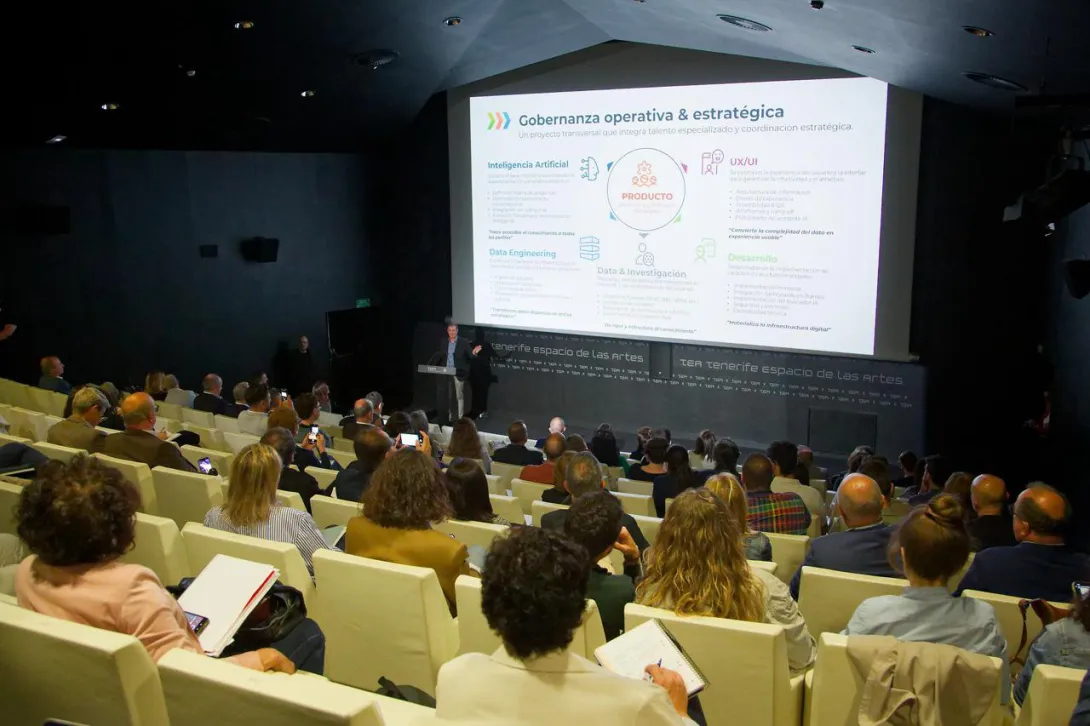
The Observatory’s governance is based on both operational and strategic management, with a central leadership structure coordinating the project through several key areas: artificial intelligence, which improves automation and facilitates access to knowledge; data engineering, responsible for building and managing the data infrastructure; analytics, which transforms information into meaningful insights; user experience design, which makes data understandable and accessible; technology development, which turns all these capabilities into digital solutions.
A more accessible and visual website
This cross-functional approach transforms the complexity of data into a user-friendly, action-oriented experience, embodied in the new Canary Islands Tourism Observatory website. One of its main innovations is the incorporation of dynamic visual tools that allow users to progressively explore information, moving from a broad overview to increasingly detailed levels of analysis while maintaining data consistency and traceability.
The new Canary Islands Tourism Observatory website incorporates a tourism flows radar, integrating advanced data on the presence and mobility of people across the territory.
In addition, an artificial intelligence layer has been integrated to provide context and interpretative capabilities for the information presented. It functions both as a data search engine and as a virtual assistant that enables interaction through questions and answers. The goal is to ensure that anyone can access information without requiring technical expertise or prior knowledge of how the data is structured.
Another significant innovation is the introduction of a tourism flows radar, which integrates advanced data on the presence and mobility of people across the territory. This information makes it possible to analyze movement patterns, concentration, and spatial behavior of residents and visitors in detail, providing a more accurate understanding of how the destination is actually used, an essential tool for future planning.
Data collection and interpretation
Developing the new website required extensive preparatory work involving the collection, organization, and interpretation of data. Once structured, this data must be transformed into knowledge, and advanced analytical models are therefore integrated at this stage to analyze information and convert it into actionable insights.
The integration of the AI layer has been key to the project, as it makes data easier to access, explore, and understand.
Artificial intelligence has been a key component of the project, facilitating data consultation and understanding through more natural interaction while ensuring that interpretations and recommendations are based on up-to-date information.
The next step is to continue enriching and expanding the Observatory by incorporating new data sources, deepening analytical models, and increasing the depth and value of the information available.