
Canary Islands presents their environmental, social and economic stustainability srategy in the United Kingdom
30/06/2026
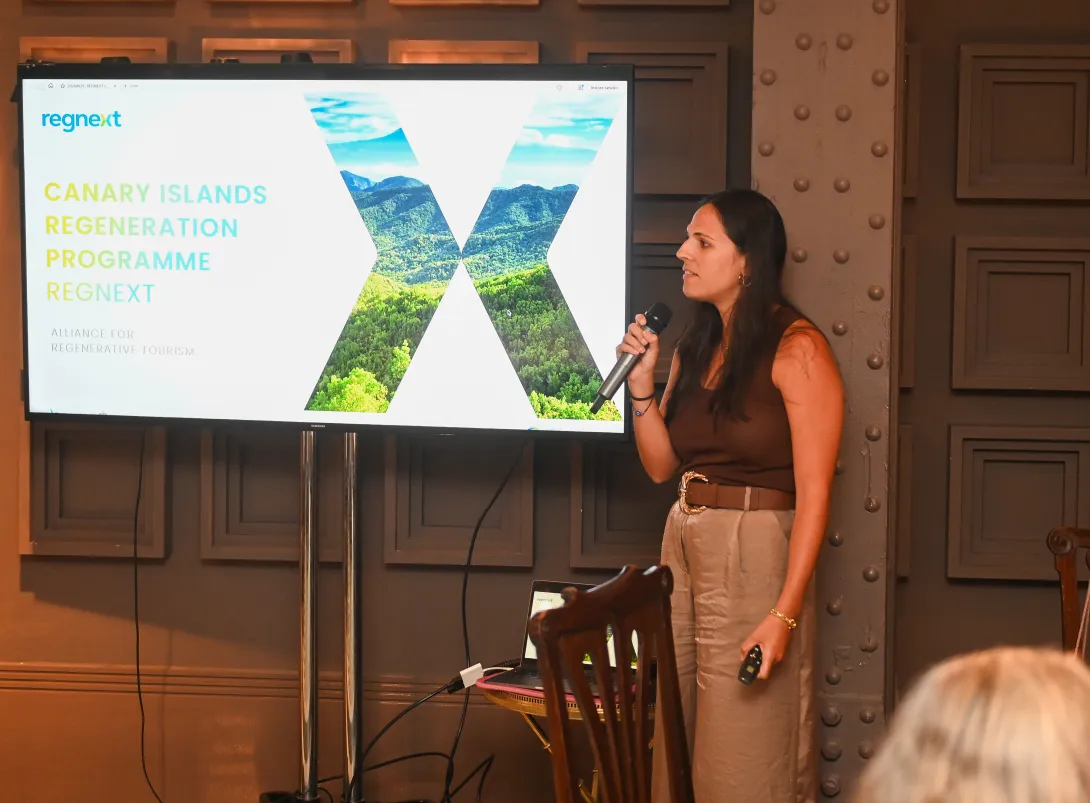
The Canary Islands Government's Minister of Tourism and Employment, Jéssica de León; the Director General for Tourism Planning, Training and Promotion, Miguel Ángel Rodríguez; the Director of the Spanish Tourist Office in London, Manuel Butler; and Isabel Florido, Environmental Sustainability Officer at the public company Turismo de Islas Canarias, presented the new measures.
The event, held as part of London Climate Action Week and organised in collaboration with the Spanish Tourist Office in London, brought together around a dozen British journalists specialising in tourism and sustainability. Representatives from ABTA, the UK's travel association, and Travel Forward (formerly the Travel Foundation), an international organisation recognised for its work on climate action in tourism, also attended.
Tourism as a Regenerative Force
RegNext is a key tool within the Canary Islands' strategy to transform its tourism model, ensuring that tourism generates greater benefits for local communities. The programme enables tourism to contribute directly to environmental and social projects while placing residents at the heart of tourism policy, reinforcing a model that is more sustainable, more equitable and delivers greater value to the Canary Islands.
Coordinated by the Ministry of Tourism together with the Ministry of Ecological Transition and Energy, RegNext was officially introduced at FITUR, while its technical development began during ITB Berlin. The programme's working group currently includes TUI, Expedia, Jet2 and Jet2holidays, easyJet Holidays, DERTOUR, Skyscanner, Carnival UK, Barceló Hotel Group, Iberostar Group, UnTours Foundation, Lopesan, Binter, Loro Parque, the Canary Islands business association Excelcan, and the tourism associations Ashotel, FEHT, Asolan and Asofuer.
RegNext will channel contributions towards projects that restore ecosystems, strengthen climate resilience and improve the territories that make tourism possible.
Through the programme, voluntary contributions from tourism businesses, climate foundations and visitors will be directed towards initiatives that ensure part of the value generated by tourism is reinvested in ecosystem restoration, climate adaptation and the enhancement of local communities and environments.
RegNext establishes a voluntary participation mechanism for tourists, businesses and organisations committed to sustainability, guaranteeing transparency, full traceability and direct funding for specific regeneration projects. Public authorities, private organisations, NGOs, community groups and associations will all be able to submit proposals, reflecting the programme's collaborative approach.
A dedicated digital platform will also be launched to make contributions simple and intuitive while ensuring complete transparency. Through the platform, users will be able to access project documentation, monitor implementation, review progress reports and verify each initiative's environmental and social impact through measurable indicators.
A New Regulatory Framework for More Sustainable Tourism
The Sustainable Regulation of Tourist Accommodation Law, which governs holiday rentals, has halted the addition of new holiday rental properties in 85 of the Canary Islands' 88 municipalities until local planning processes - developed through democratic participation- determine how many properties can operate, where they may be located and under what conditions.
The Sustainable Regulation of Tourist Accommodation Law has already halted the expansion of new holiday rental properties in 85 of the Canary Islands' 88 municipalities.
Regarding the existing market, around 1,500 holiday rental properties have voluntarily withdrawn from the General Tourism Register. Going forward, this type of accommodation will be developed according to sustainability principles that protect urban environments, encourage social integration and comply with territorial planning and strategic environmental assessment criteria.
The presentation also outlined additional measures designed to strengthen a more balanced and sustainable tourism model. These include proposed reforms to the regulations governing active tourism, making it easier for young professionals to enter the sector while improving the management of outdoor activities through qualified instructors and guides.
Finally, British journalists were informed about the forthcoming introduction of the Canary Islands' first regulations governing campsites, camping areas and other unique accommodation facilities. This long-awaited framework is expected to support the restoration of coastal areas, improve the quality and competitiveness of the camping sector, create new employment opportunities and contribute to the long-term conservation of the archipelago's natural environment.