
Canary Islands at Fitur: the archipelago and the tourism sector join forces to turn tourism into a driver of environmental and social regeneration
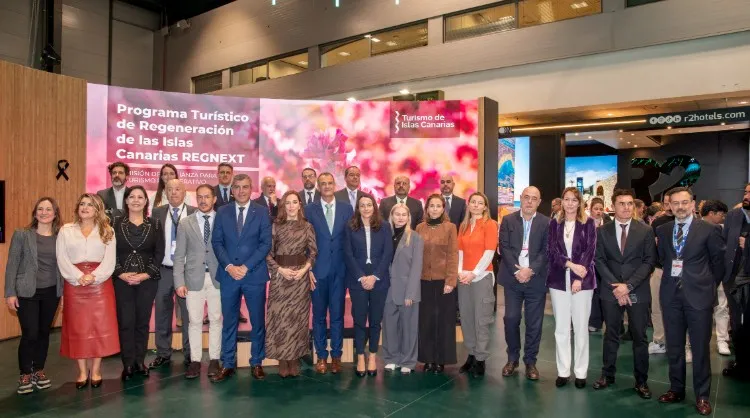
The participation of leading international tourism operators in the RegNext program demonstrates that both the private and public sectors share the same goal: tourism should not only reduce its footprint but also generate a measurable positive impact on the territory, biodiversity, and social cohesion of the archipelago.
This initiative, managed by Turismo de Islas Canarias, is aligned with our strategy to ensure that the wealth generated by tourism returns to the territory in the form of ecological, social, and cultural value. It also strengthens the international reputation of the Canary Islands as a laboratory for sustainability and climate transition, placing them at the forefront of regenerative tourism.
Tourism should not only reduce its footprint but also generate a measurable positive impact on the territory, biodiversity, and social cohesion of the archipelago.
Five pilot projects
The Commission will include high-level technical profiles from the involved ministries, as well as airlines, tour operators, OTAs (online travel agencies), tourism associations, and environmental NGOs. They will work to finalize the operational design of the program, propose improvements to participation models, and contribute to the selection of the first projects, submitting a final proposal to the Government of the Canary Islands in June.
In the initial phase of RegNext, five pilot projects will be selected: one on each of the islands with the highest tourism pressure, and another cross-cutting project of a social nature covering the entire archipelago. To implement them, the Commission will design a voluntary, traceable, and transparent financing system that will allow resources to be directly and specifically allocated to regeneration projects.
In the initial phase of RegNext, five pilot projects will be selected: one on each of the islands with the highest tourism pressure, and another cross-cutting project of a social nature across the entire archipelago.
To ensure this transparency and traceability, participants will be able to monitor project progress and track environmental and social results achieved, such as emissions reduction, habitat restoration, species recovery, landscape improvement, green job creation, and poverty reduction.
The implementation of this program will rely on a robust governance structure based on public-private collaboration, transparency, accountability through continuous audits, and the active participation of the tourism sector, public administrations, and civil society.
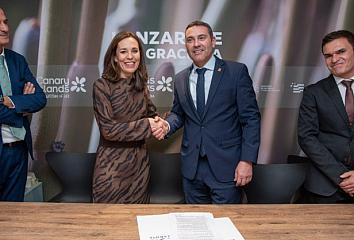
The memorandum was signed by the Vice President of the Government of the Canary Islands, Manuel Domínguez; the Minister of Tourism and Employment, Jéssica de León; and the Minister of Ecological Transition and Energy, Mariano H. Zapata, along with representatives from TUI, Expedia, Jet2 and Jet2holidays, easyJet Holidays, DERTOUR, Barceló Hotel Group, Lopesan, Binter, and Loro Parque, as well as the Canary entity Excelcan and tourism associations Ashotel, FEHT, Asolan, and Asofuer. Sector organizations and strategic alliances such as UN Tourism and The Travel Foundation, as well as the island councils, also supported the signing of this agreement.
A more sustainable tourism model that distributes wealth more effectively
Yesterday marked the opening of the 46th edition of the International Tourism Fair of Madrid (Fitur), in a context where the Canary Islands continue to move steadily toward a more sustainable tourism model that generates greater value for the archipelago. The Islands closed 2025 with an average tourist expenditure of €1,450, which is €314 more than in the year before the pandemic. This figure, along with a 44% increase in total revenue compared to 2019, confirms the commitment to improving visitor quality and spending.
Tourism employment in the Canary Islands has also benefited from the sector’s strong performance, reaching 280,534 people, 4% more than in 2024.
Tourism employment has also benefited from the sector’s strong performance. According to the latest Labour Force Survey (EPA, third quarter), employment linked to tourism reached 280,534 people, 4% more than in 2024. This positive trend has played a decisive role in bringing unemployment in the Canary Islands to historic lows.
1,300 professionals and 380 companies
The Canary Islands destination is attending this edition of Fitur with more than 1,300 accredited tourism professionals and 380 companies from the archipelago. Once again, the total carbon footprint associated with participation has decreased, from 70.5 tonnes of CO₂e in the previous edition to 64.5 tonnes this year—an 8.5% reduction. The carbon footprint per attendee has also been reduced, from 201.5 kilograms of CO₂e per person to 191.5 kg CO₂e, representing a 5% decrease.
Once again, the total carbon footprint resulting from the Canary Islands’ participation at Fitur has decreased.
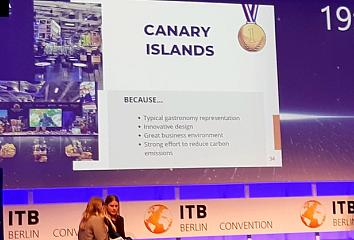
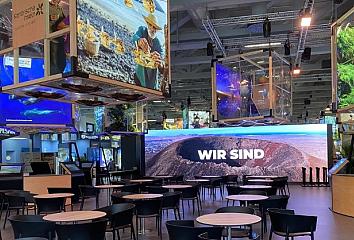
Last year, a new stand was unveiled at Fitur, where it also received the award for Best Stand in the Institutions and Autonomous Communities category. Co-financed with ERDF funds, the stand is characterized by its avant-garde and sustainable design. It covers 1,768 m² and includes dedicated spaces for media, tourism companies, and an auditorium with capacity for 120 people, where presentations by island councils, public companies of the Ministry, and other institutions and entities are held. Its striking roof structure, cutting-edge aerial elements, and graphic displays—covering more than 600 m²—also stand out.
As a new feature this year, a Canary coffee tasting area has been added, organized by Hecansa, alongside the traditional juice bar offering local fruits and a tasting area for local products and wines managed by the public company GMR.